


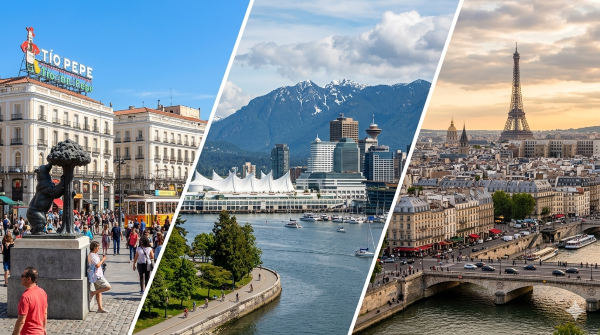
I’ve been in Madrid for a few days. This morning, like yesterday, like the day before, I opened my laptop on a terrace. Coffee, sunshine, the background hum of a city waking up. And I worked. Actually worked.
Nobody asked if I was focused. Nobody counted my hours. Nobody checked that I was sitting in front of a screen in a closed room.
And yet the deliverables came out. Emails got answered. Projects moved forward.
Strange, right?
This isn’t the first time I’ve felt this
I worked in Vancouver. In commercial real estate, at one of the biggest firms in the sector. A city that combines serious economic performance with a relationship to work that French people would find almost suspicious — it looks too relaxed to be real.
Over there, nobody watches what time you arrive at the office. They watch what you produce. Meetings last as long as they need to, not a minute more. And if you deliver from a café in Gastown with a view of the mountains, nobody’s going to check whether you were “really” working.
The result was there. That was enough.
Madrid gives me exactly the same feeling. In the coworking spaces of Malasaña, in the cafés of Chueca, on the terraces of La Latina — people are working. Seriously. Just without the theatre of presenteeism.
In France, we confuse presence with performance
Back to Paris for a second. How many French managers still measure their team’s productivity in hours of physical presence? How many employees feel obliged to turn their camera on in video calls to “prove” they’re working?
We invented the entry badge, the tracking software, the “where were you this morning”, the weekly activity report. A whole surveillance apparatus to compensate for one single thing: the inability to trust.
The problem isn’t remote work. The problem is that we never learned to manage without visual control.
Productivity is measured, not monitored
A team member who delivers projects on time, hits their objectives, shows up when needed — what difference does it make whether they’re in an open-plan office in La Défense or on a terrace in Madrid?
The honest answer is: none. Absolutely none.
Except for the manager who needs to see to believe. The one for whom the office is proof of commitment, not a work tool. The one who confuses loyalty with geolocation.
This profile exists. It’s even the majority in many French companies. And it’s exactly that profile blocking widespread remote work — not the technology, not security, not the actual productivity of teams.
What Madrid and Vancouver confirmed for me
Two cities. Two cultures. One same observation: when you trust people, they deliver. When you control them, they optimise for the control. That’s not terrace philosophy — it’s field observation over several years.
Remote work shouldn’t be a favour granted by a benevolent manager. It should be the logical consequence of demonstrated performance. You deliver, you’re autonomous, you communicate: work from wherever you want. You don’t deliver: let’s talk about it — and where you work isn’t the subject.
Simple. Measurable. And it puts responsibility on everyone, the team member and the manager alike.
The Spanish and Canadians didn’t invent the concept. They just apply it with fewer hang-ups.
Tomorrow I fly back to Paris. Madrid will be missed. The terrace most of all.
At my company things work fine — the trust is there. But the echoes you hear elsewhere are sometimes more complicated. Presenteeism dies hard, and changing a management culture doesn’t happen over an extended weekend in Madrid.
Even if it would probably help.