


Honestly, I didn’t see it coming.
I was a Product Owner. My job was to bridge the gap between people with ideas and people who code. I wrote user stories, ran Scrum ceremonies, defended priorities in meetings. A translator’s job, when you think about it. Useful, but mostly… very procedural.
Then AI showed up in my daily life.
When the machine does your job in 30 seconds
The first shock came when I asked ChatGPT to write user stories from a vague brief. It produced something solid in a few seconds. Better structured than what I used to build after an hour of work. Honestly, that hit hard.
Prioritizing a backlog, generating specs, documenting a feature: everything that used to fill my afternoons could now be done in a few prompts.
I could have panicked. I could have declared the end of the world.
Instead, I changed the question. Not “will AI replace me?” but “what do I do now that I’m free from all of this?”
I stopped managing. I started building.
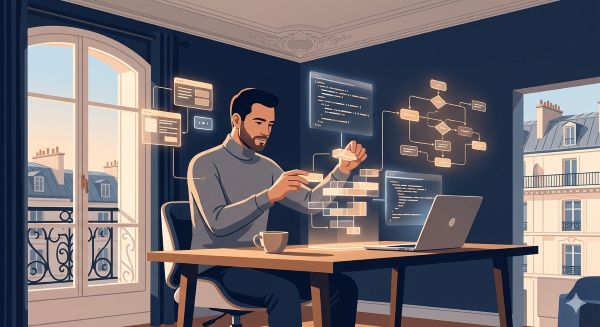
That’s when the title changed in my head. Product Builder, not Product Owner.
The difference is simple: before, I managed a backlog. Now I build things. Directly. Without waiting for a squad of eight people to validate three sprints before testing an idea.
No-code, low-code, AI agents, automations: I assemble bricks. I prototype in an afternoon. I test with real users within 72 hours. What used to take weeks now takes days. What used to require a whole team, I often do alone.
Tools like Bubble, Make, or n8n made this possible for any product person with a bit of curiosity. It’s not magic. The tools just finally caught up with the ambition.
What AI will never do for me
Let’s be clear: I don’t live in a LinkedIn ad.
AI generates, it doesn’t feel. It doesn’t know why a user gets stuck on the third field of your form. It doesn’t pick up the frustration in a client’s voice during a usability test. It can’t tell the difference between a real pain point and a management whim.
That’s still my job. Understanding people, identifying real problems, making the right calls. AI helps me move faster toward answers. It doesn’t find the right questions for me. That’s well documented in current thinking on AI and Product Management.
What I truly lost, and what I gained
I lost endless meetings. Specs nobody reads. Debates about team velocity.
I gained the ability to test a hypothesis without asking everyone’s permission. I gained speed. And honestly, I gained back my enjoyment at work.
Becoming a Product Builder isn’t a disguised demotion. It’s understanding that the real work is solving problems, not managing a ticketing tool. Voices like Lenny Rachitsky have been saying it for years: Product Management is evolving toward more direct execution.
So, did the job disappear?
No. It evolved.
AI didn’t kill the Product Owner. It killed the boring version of the job. The one that spent its days filling boxes instead of thinking.
What remains is the essential part: the vision, the human connection, and the ability to assemble the right pieces at the right time.
AI didn’t eliminate the job. It eliminated the excuse of not knowing how to do things.
So what are you waiting for?